From the origins to today
Our History
A story of passion, culture and Venetian tradition, and it begins with a shipwreck.
A passion for tradition
The Confraternita del Baccalà Mantecato was founded in 2001, the idea of Dino Boscarato, patron of the Trattoria dall’Amelia in Mestre. It was presented to the public at a solemn ceremony in the Scuola Grande San Giovanni Evangelista in Venice, and refounded in 2003 with a more formal structure.
The Confraternita brings together enthusiasts, connoisseurs, gourmets and food historians who care about tradition and about safeguarding the original recipe behind this delicacy of Venetian cuisine. It is governed by a Council of Ten, the Consiglio dei Dieci of Serenissima custom, and presided over by a Doge.
To connect those who love baccalà mantecato with those who serve it, the Confraternita awards the title of Selected Restaurant to establishments that accept its charter and pass the judgement of the Savio di Bocca, the “Sage of the Palate”: chef Franco Favaretto of the BaccalàDivino restaurant in Mestre.
Venice, where stockfish becomes cream
Pietro Querini, the first Venetian to “discover” stockfish, was a patrician and a feudal lord in Candia. In April 1431 he sailed from Crete aboard a cog, a round-hulled cargo ship able to carry 446 tonnes per voyage: casks of Malvasia wine, sacks of pepper and spices, bales of cotton, rolls of silk, chests of tapestries and glass, all bound for the thriving markets of Flanders.
The Querina, as the ship was called, never arrived. Caught in a storm off the island of Ushant, she was driven far past Ireland, without sail or rudder. On 17 December the crew abandoned the wreck, dividing the men and the few remaining provisions between a longboat and a smaller launch.
The longboat was never seen again. The launch, carrying Querini and forty-seven sailors, drifted at the mercy of the waves until it reached the deserted islet of Sandøy, in the Lofoten archipelago, beyond the Arctic Circle.
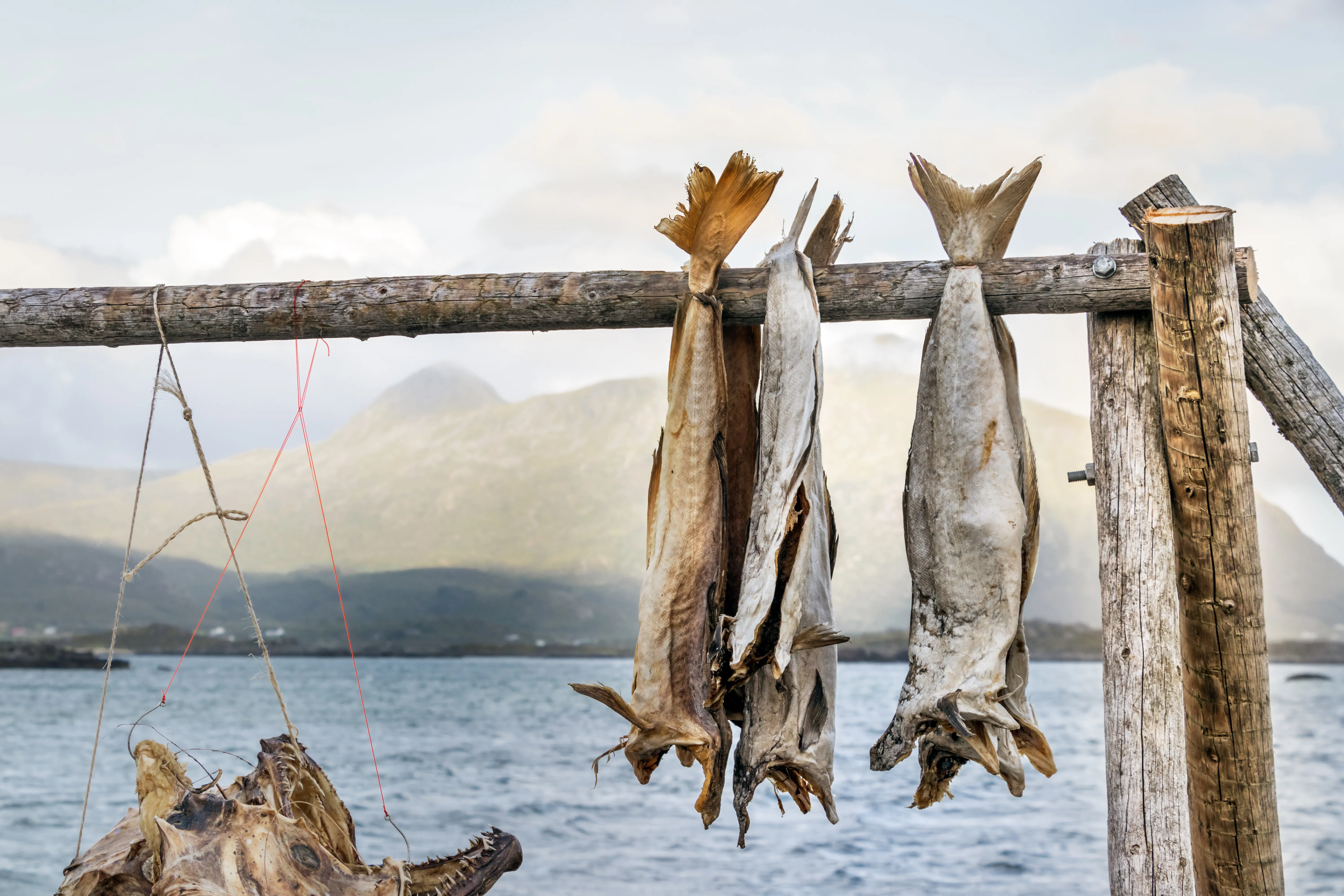
Reduced to barely a dozen men, the castaways were rescued after eleven days by the generous fishermen of the nearby island of Røst. It was there that Querini discovered stockfish, stocfisi as he called it, from the Norse stockvisch: stick fish. Cod hung to dry in the pale sun and icy winds of the Lofoten becomes hard, quite literally, as a stick.
Querini was only able to sail again on 15 May 1432, heading like the local fishermen for the busy port of Bergen. He and his men were given a provision of sixty stockfish, which they sold to pay for the voyage home to their beloved Venice, reached at last on 12 October.
We owe to the historian Alberto Tenenti the discovery, among the inexhaustible papers of the Venice State Archive, of the Flemish merchant Marco Manart, the first privileged importer of bacaladi into Venice by sea. Early in 1596 Manart petitioned the Senate for a reduction in duties on a merchandise never before landed in the city: the fish called stocvis, together with oil rendered from whale flesh.
Baccalà, whipped into art
Ever since, baccalà, whipped according to the traditional Venetian recipe or in its countless local variations, has held its place on Italian tables.
How refined, indeed most refined, is baccalà mantecato, a supremely Venetian dish if ever there was one: a true mousse, not to be confused with the French brandade de morue, nor with Pellegrino Artusi’s cream-laden “baccalà montebianco”.
So wrote Alvise Zorzi, writer, journalist and historian of all things Venetian, in his preface to Il Baccalà dei Veneziani, a delightful volume devoted to the history and recipes of baccalà.